When this helps
You are debugging a PDF generator, investigating a metadata discrepancy or checking what a reported action refers to. The technical views let you inspect the underlying representation without making every reader learn PDF syntax.
Try it in the checker
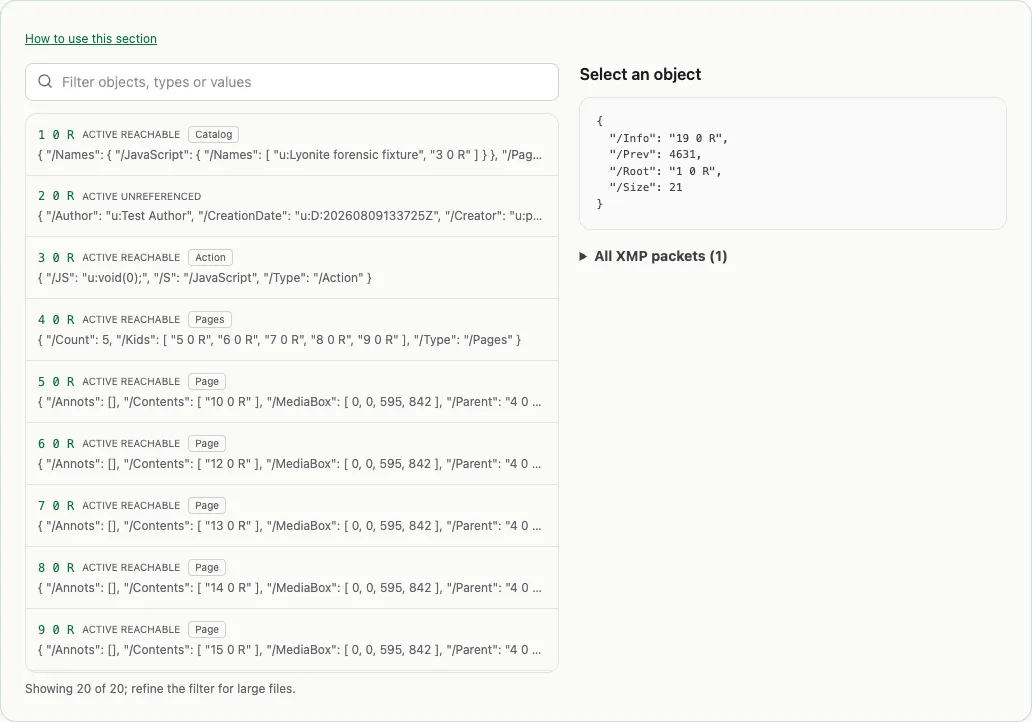
In Everything, choose Objects & XMP. Filter by an object number, type or value, then select a record to read its preview or byte window. Decode stream is available for supported current streams. Historical records must be interpreted in their saved-version context.
Expand the XMP list to read packets found in the current object table, including packets marked unreferenced. Current XMP source elsewhere in Everything is the packet referenced by the current document. For byte inspection, select Raw bytes, search for text or hex, and use the offset to open a bounded window.
Read the result in context
A match for an old author name in raw bytes proves the string is present. It does not prove the author is current. The same number can identify different object definitions across saves, and compressed objects do not necessarily have a directly readable byte location.
When a result matters, record the file hash, object reference, saved-version context and coverage. Export JSON/ZIP to preserve the structured records. A screenshot alone may leave out exactly the context another reviewer needs.
What this cannot establish
The tool is a bounded browser inspector, not an exhaustive parser or malware sandbox. Raw matches and superseded-object candidates can require independent confirmation. Decoding does not execute JavaScript or establish whether a script is malicious. Unsupported filters, encrypted content and damaged structures may be unavailable. The original bytes remain the source of truth.